International Conference on Machine Learning (ICML) is the premier venue for machine learning research. In 2026, the conference received over 23,000 peer-reviewed submissions, of which approximately 6,300 were accepted – an acceptance rate of around 26.6%. Among the accepted papers, 168 were selected as orals, 574 as spotlights, 213 as position papers, and the remainder as poster presentations. With a volume of this scale, it is virtually impossible for any individual to read through the full proceedings and extract the key themes. In this post, I attempt to summarize the most important statistics from the accepted papers and identify the emerging trends and focus areas that are likely to shape the trajectory of ML and AI research in the years ahead by looking at their titles and abstracts.
2D Visualization: Abstract Word Clusters
Using TF-IDF vectorization on all abstracts, reduced to 2D via PCA, and clustered with KMeans (k=8), we can see how ICML 2026 research naturally organizes into distinct communities:
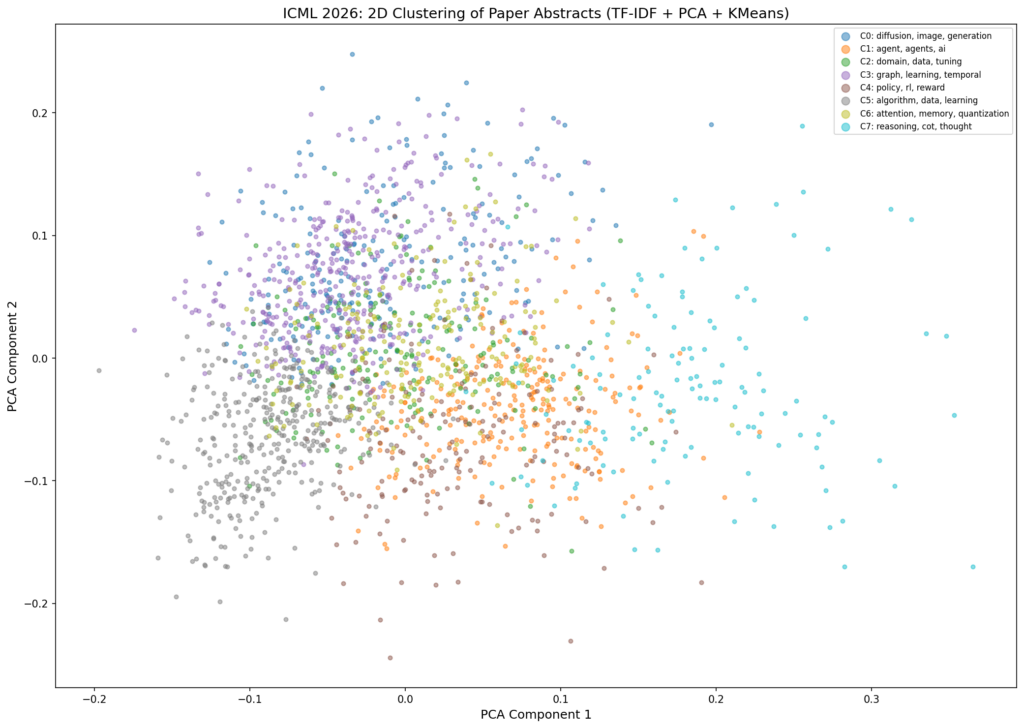
Cluster Interpretation
| Cluster | Top Keywords | Research Area |
|---|---|---|
| ● C0 | diffusion, image, generation | Generative Models |
| ● C1 | agent, agents, AI | Agentic Systems |
| ● C2 | domain, data, tuning | Fine-tuning & Adaptation |
| ● C3 | graph, learning, temporal | Graph & Time-Series ML |
| ● C4 | policy, rl, reward | Reinforcement Learning |
| ● C5 | algorithm, data, learning | Theory & Optimization |
| ● C6 | attention, memory, quantization | Efficient Architectures |
| ● C7 | reasoning, cot, thought | LLM Reasoning |
Key observation: Reasoning/LLM papers (C7, right side) are clearly separated from traditional ML theory (C5, left side), while generative models and RL occupy their own distinct territories. The overlap between C1 (agents) and C7 (reasoning) suggests these areas are converging.
Word Cloud from Abstracts
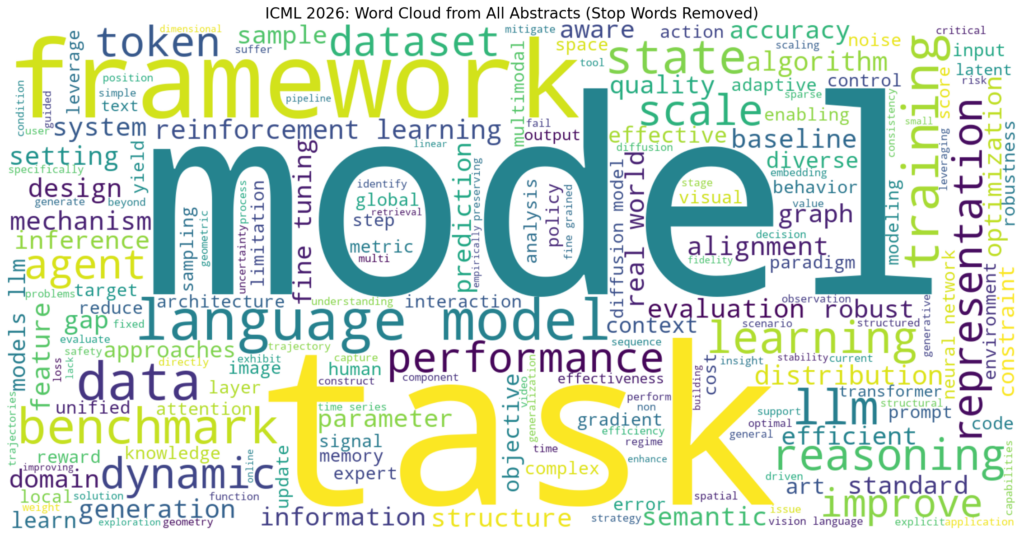
We can observe the word cloud is dominated by framework, language model and task.
Key Themes that Dominate ICML 2026
1. Large Language Models (LLM)
LLM research now spans reasoning, alignment, efficiency, evaluation, and applications across every domain. LLMs are no longer just an NLP topic – they have become the substrate for vision, code, science, and autonomous agents.
2. Reasoning & Test-Time Compute
The “thinking models” wave. Papers on chain-of-thought, process reward models, verifiers, test-time scaling, and mathematical/logical reasoning reflect the post-o1 research explosion. GRPO alone appears in 155 papers – a clear signal that reinforcement learning–based reasoning optimization is now mainstream.
3. AI Safety, Alignment & Red-Teaming
From jailbreaking and red-teaming (71 papers) to RLHF/DPO preference optimization (241 papers), watermarking, unlearning, and reward hacking – safety is now a first-class research area, not a niche. The community is investing heavily in making models trustworthy and robust.
4. Efficiency at Every Layer
Quantization, LoRA/low-rank methods (396 papers), speculative decoding, KV cache optimization, pruning, and model compression. The focus has shifted from “can we train it?” to “can we deploy it affordably?” Efficiency is no longer an afterthought – it is central to the research agenda.
5. Agents & Tool Use
LLM-based agents, agentic workflows, multi-agent systems, code agents, and tool calling. The autonomy layer on top of foundation models is rapidly maturing, with research addressing planning, memory, collaboration, and real-world deployment of autonomous systems.
6. Multimodal & Vision-Language Models
Vision-language models (VLMs), multimodal reasoning, text-to-image/video generation, and visual chain-of-thought. The convergence of vision and language into unified architectures is now a dominant paradigm rather than an emerging one.
7. Diffusion & Generative Models
Diffusion models remain strong, but flow matching (117 papers) is gaining ground as a compelling alternative. Text-to-image (170 papers), text-to-video (80 papers), and controllable generation continue to push the boundaries of what generative models can produce.
8. Reinforcement Learning Reinvented
RL is resurgent – but its role has transformed. It now largely serves LLM training (RLHF, GRPO, reward modeling) rather than game-playing or robotics alone. Multi-agent RL and offline RL remain active sub-areas, but the gravity has shifted toward language model optimization.
9. AI for Science
Proteins, molecules, drug discovery, materials science, and weather/climate modeling. Scientific ML is a major application vertical with dedicated methods, architectures, and benchmarks – representing some of the highest-impact potential in the entire conference.
10. Scaling Laws, Data Curation & Synthetic Data
How to train better with less: data selection and curation (78 papers), synthetic data generation (151 papers), scaling laws (515 papers), and data mixture strategies. The “data engineering” of foundation models has emerged as a research discipline in its own right.
11. Interpretability & Mechanistic Understanding
Sparse autoencoders, circuit-level analysis, and feature visualization – the field is moving beyond post-hoc explanations toward mechanistic understanding of model internals. While still smaller in volume, this area carries outsized importance for building trust in AI systems.
12. Architectures Beyond Vanilla Transformers
State space models/Mamba (188 papers), Mixture of Experts (130 papers), linear attention, and RWKV represent active exploration of alternatives that trade the transformer’s quadratic attention cost for sub-quadratic efficiency – without sacrificing performance.
13. Robotics & Embodied AI
Foundation models for robotics, manipulation, navigation, and embodied planning. This area represents the critical bridge from language/vision intelligence to physical action in the real world – and it is growing fast.
Position Papers and their Influence on Future AI Research
Goal of Position papers at ICML (and ML conferences generally) is to present a well-argued opinion, perspective, or critique on an important issue facing the field – without necessarily requiring novel algorithms, experiments, or empirical results.
They typically aim to:
- Provoke discussion – Challenge assumptions, highlight overlooked risks, or question prevailing research directions
- Shape research agendas – Argue for where the community should focus (or stop focusing) its attention
- Raise awareness – Surface systemic issues like evaluation practices, reproducibility, ethical concerns, or governance gaps
- Synthesize and reframe – Offer a new lens on existing work rather than new technical contributions
ICML 2026 accepted around 213 position papers – a clear signal that the ML community is engaging deeply with meta-scientific, ethical, and governance questions alongside technical advances.
Distribution by Category
| Category | Count | Representative Topics |
|---|---|---|
| AI Safety & Alignment | 92 | Dual-use alignment tools, agentic AI risks, economic threats, child safety, AI lock-in, censorship concerns |
| Evaluation & Benchmarking | 43 | Broken benchmarks, peer review crisis, domain-specific evaluation, reproducibility gaps |
| LLMs & Foundation Models | 25 | Hallucination definitions, reasoning limitations, synthetic data collapse, NL vs formal languages |
| AI Governance & Policy | 18 | ISO-like interoperability protocols, model card reform, privacy-auditability paradox, MCP trustworthiness |
| Agents & Multi-Agent | 6 | Agent security redefinition, agentic AI as pathway to AGI, general agents, behavioral testing |
| Scientific AI & Domains | 4 | Physics-specific LLMs, genomic evaluation, numerical precision impact |
| Societal Impact & Sustainability | 3 | Big tech’s irresponsible influence, carbon footprint reporting, open-source economics |
| Other | 22 | AI welfare critique, aesthetic alignment, continual learning, data probes |
Key Takeaways from Position Papers
- Safety dominates the conversation – Nearly half of all position papers address safety, with novel arguments that alignment tools are dual-use, safe models ≠ safe societies, and agentic AI demands entirely new safety paradigms.
- The evaluation crisis is real – Widespread agreement that current benchmarks are broken, non-reproducible, culturally biased, or misaligned with actual deployment needs.
- The governance gap is widening – AI capability races faster than regulation. Multiple papers call for ISO-like technical standards rather than just jurisdiction-specific laws.
- Agentic AI needs guardrails before deployment – Position papers argue for unified environments, security redefinition, behavioral testing, and certification before agents enter economic markets.
- Data provenance is a looming crisis – As synthetic data proliferates and model collapse becomes reality, the community cannot trace claims to verifiable sources.
Established Themes vs. Emerging Trends
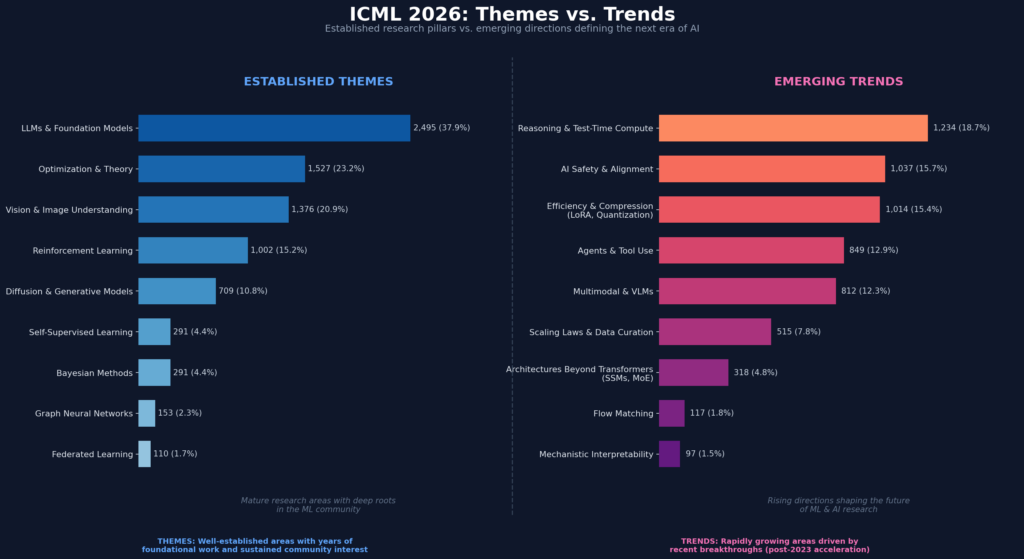
Trends Expected to Dominate ML/AI Research in Next 2 Years
By counting keyword frequencies across all papers titles and abstracts, a clear hierarchy of research focus emerges:
| Rank | Research Theme | Mentions | 2-Year Outlook |
|---|---|---|---|
| 1 | LLMs / Large Language Models | 11,190 | Continued scaling, domain-specific LLMs, new architectures beyond transformers |
| 2 | Agentic AI / Multi-Agent Systems | 4,874 | Autonomous tool-using agents, multi-agent collaboration, agent security |
| 3 | Reasoning / Chain-of-Thought | 3,890 | Test-time compute, verifiable reasoning, formal verification |
| 4 | Efficiency (Quantization/Pruning/Distillation) | 3,611 | 2-3 bit quantization, MoE sparsity, on-device deployment |
| 5 | Generative Models | 2,937 | Video generation, 3D synthesis, flow matching replacing diffusion |
| 6 | Reinforcement Learning | 2,774 | RL for LLM post-training, robotics, preference optimization (DPO variants) |
| 7 | Transformers / Attention | 2,695 | Linear attention, state-space models, hybrid architectures |
| 8 | Multimodal / Vision-Language | 2,183 | Unified models for text+image+video+audio, interleaved reasoning |
| 9 | Alignment / Safety / RLHF | 2,155 | Regulatory pressure, red-teaming, constitutional AI, governance frameworks |
| 10 | Time Series / Forecasting | 1,536 | Foundation models for time series, domain-specific benchmarks |
Summarizing Key Focus for Next 2 years (2026–2028)
- Agentic AI goes mainstream – Tool-using, multi-step autonomous agents will move from research prototypes to production systems. Expect standardized agent protocols (MCP, A2A) and agent-native operating systems.
- Reasoning at inference time – Models that “think longer” via test-time compute (search, verification, self-correction) will outpace fixed-forward-pass models. Chain-of-thought becomes chain-of-verification.
- Efficiency becomes non-negotiable – 2-3 bit quantization + Mixture of Experts + speculative decoding will enable frontier-quality models on consumer hardware and mobile devices.
- Multimodal unification – Single models handling text, vision, audio, video, and code natively will replace pipeline-based systems.
- Safety/alignment becomes regulatory – The 213 position papers signal imminent governance frameworks. Expect mandatory model cards, behavioral certification, and carbon reporting.
- World models for robotics – Simulation-trained policies transferred to real robots, driven by video prediction and physics-aware generation.
- AI for science accelerates – Protein design, drug discovery, materials science, and weather prediction papers show these fields reaching practical deployment.